Serving Greater Boston and RI Since 1978
Excellent Reviews
5.0 Rating
Serving Greater Boston and RI Since 1978
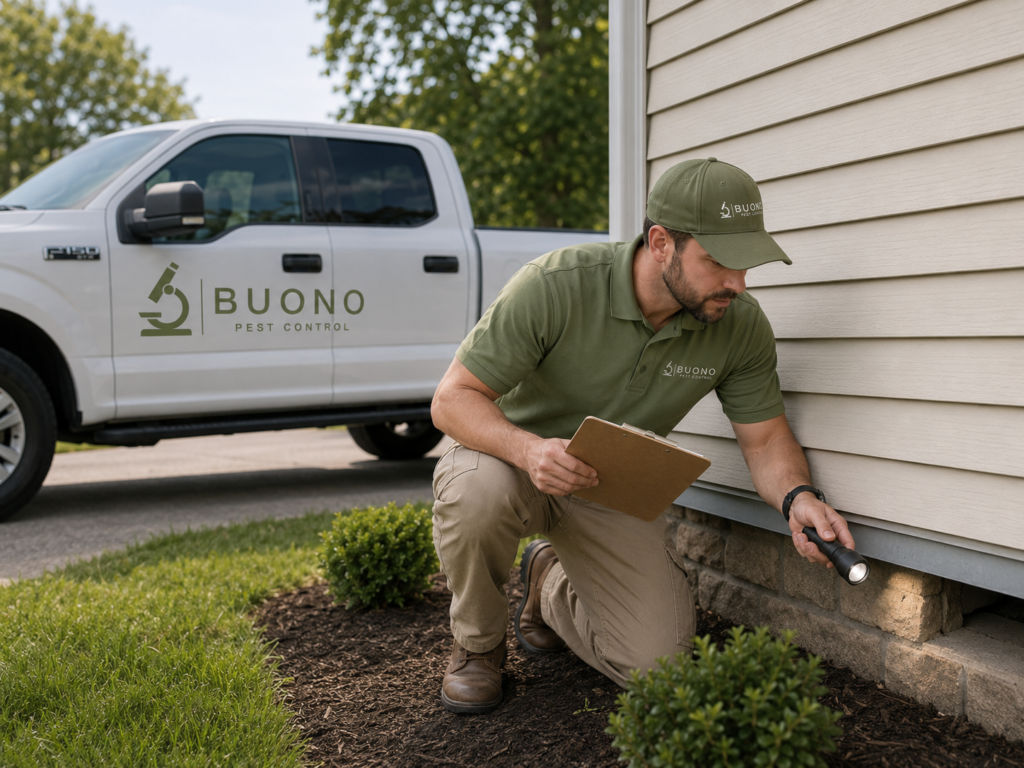
Mice need a gap the width of a pencil, and rats one the size of a quarter. A gap that size is invisible from the curb, which is why a sealed-looking house stays open. Those gaps are what Buono Pest Control looks for, then closes with mesh, cement, or a trench below grade.
Trapping clears the rodents already inside a building, and that is where most jobs stop. Those rodents come back, because the openings that let the first ones in are still open. Each of those openings, whether a foundation crack, a gap under a bulkhead door, or an unsealed sill plate, stays usable until somebody closes it.
Buono therefore works the structure before the interior, following the runs, droppings, and rub marks back to where they come from. Each gap gets measured against what a mouse or rat can pass through, and those measurements set the material. Once every route on that list is closed, the trapping inside finishes the job and nothing replaces what it removes.
The order matters here, since every closure depends on the inspection that found the opening:
Droppings and runs tell the technician whether mice or rats are working the building, and those same runs lead back to the openings they enter through.
Each opening on that list gets a material and a method, so the quote separates what a sealant will close from what needs trenching or cement.
Crews close those mapped openings with mesh, sealant, and cement, while baiting handles the rodents that were already inside when the work started.
A follow-up visit reads the monitors and re-checks each closure, because one opening left behind lets the population build back to where it started.
Every pest problem is different. Buono identifies the source, recommends the right service plan, and stays responsive from the first call through every follow-up visit, using licensed technicians on every job.
Four measures close a Belmont house, and they run in this order because each one exposes what the next has to handle:

Door sweeps, dryer vents, utility penetrations, and foundation cracks account for most entries, so closing them first clears the easy routes and leaves the harder ones visible.

What stays open after that is usually a vent, since soffits, foundation vents, and weep holes were built to pass air and rarely got screened. Stainless mesh closes those vents without choking the airflow they were built for.

Rats go under what they cannot go through, tunneling beneath a slab or stone foundation where sealant has nothing to grip. Buono trenches along that foundation line and sets a barrier below grade.

A caulk gun reaches the gaps in plain sight and leaves the ones behind appliances, inside soffits, and below grade. Professional rodent exclusion services reach those hidden gaps too, so the house holds through the following winter.
Family-Owned & Operated Since
Buono has sealed and trenched Belmont foundations since 1978, and the same family still runs the company. The exclusion side grew out of a construction background inside that family. That construction experience is why masonry and structural repair happen on the same visit rather than waiting on a subcontractor.
Belmont’s housing stock sits largely on fieldstone and rubble foundations, and those mortar joints open as the stone settles. Those open joints run through to the sill, giving mice a path interior trapping never reaches.
That path gets used harder on dense two-family lots, where a population pushed out of one building crosses to the next. Buono therefore works the whole building and the grade line around it, since a house closed on three sides stays open on the fourth.
Three questions come up on nearly every exclusion estimate, and each one follows from the last:
Rodent exclusion is the practice of closing every opening a mouse or rat can use, so the building stops admitting them. How rodent exclusion works is mechanical rather than chemical, which is why the inspection does most of the work.
That inspection is where a technician finds each entry point, measures it, and covers or fills it with something rodents cannot gnaw. Trapping deals with the animals already inside, while exclusion removes the access that brought them, and only exclusion keeps working after the technician leaves.
The material has to match the opening, so rodent exclusion materials get picked gap by gap. Steel wool for rodent exclusion packs tight around a pipe, though it rusts, so a sealant goes over it. Copper mesh does the same job and never rusts, which makes it the choice for damp basements and exterior penetrations.
Rodent exclusion foam holds that mesh in place rather than standing alone, since rodents chew through foam on its own. Anything wider than those gaps goes to sheet metal, hardware cloth, mortar, or concrete.
Commercial rodent exclusion carries a harder standard, because an inspector who finds droppings in a food area writes it up on the spot. That exposure is why Buono runs commercial rodent exclusion services inside a recurring program, with mapped openings, documented closures, and monitors read at every visit.
Each building type fails in its own place, from dock door seals in a warehouse to the utility chases between units in multi-family housing. Those buildings are never named, because Buono does not disclose a commercial client.
Rodent exclusion cost follows the number of openings and the work each one takes, which is why two houses on the same street can quote differently. A dozen sealed openings on a newer build sits at one end of that range. A fieldstone foundation needing trenching and masonry sits at the other end of the same range. Only a walk-through separates the two, so Buono quotes after seeing the property rather than off photographs.

Exclusion is the structural side of rodent control, so the work happens on the building rather than on the rodents. On that building, Buono closes the gaps, vents, and below-grade routes rodents use, with materials they cannot chew. Trapping clears the rodents already inside while those closures go in.
It works once every opening is closed, and fails on the one that gets missed. A single opening left behind an appliance keeps the route open, and the population rebuilds through it. Buono re-checks every opening on a follow-up visit, which is when a missed one shows up.
Cost tracks the number of openings and whether any of them need trenching or masonry, so Buono quotes after seeing the property. Residential estimates cost nothing. Whether rodent exclusion is worth the cost usually comes down to how long you have been paying for trapping instead.
Buono covers Belmont, Boston, Cambridge, Newton, Watertown, Waltham, Lexington, Lincoln, Bedford, and Concord, plus the surrounding counties in Massachusetts and Rhode Island. Anyone searching rodent exclusion near me or rodent exclusion services near me from those counties reaches the same Belmont office at (617) 489-3008.
Residential rodent exclusion estimates are free, and so is the walk-through that produces one. Free inspections are reserved for commercial proposal submissions, which run through the commercial bid process. That process is separate, so a residential estimate is booked by calling the Belmont office at (617) 489-3008.